A 3-in-1 (three-in-one) phone usage scenario appeared since the first version of Bluetooth specification.
Definition
It refers to a handset that can function as
1. mobile (cellular) phone when out and about within a cellular network coverage,
2. cordless phone when at home, near a fixed line (landline) telephone base station,
3. intercom (walkie-talkie) when two persons are establishing a direct speech connection in close distance.
To enable the latter two (points 2 and 3), the specification defined TCS (Telephony Control Signaling) Binary Profile which is the basis of Corldless Telephony Profile (CTP) and Intercom Profile (ICP).
Benefits
It shows a fixed-mobile convergence (though only in handset since other convergence issues relate to core network, management, numbering, billing and handover mechanism) and it allows users to bypass cellular operators when communicating within Bluetooth range. These may result in lower monthly communication bill.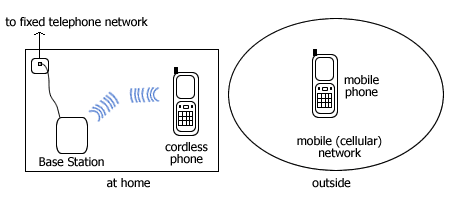
If your Bluetooth mobile phone supports CTP, you don't need another cordless phone at home to receive or make a landline call.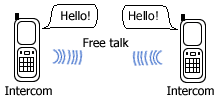
And if in addition it also supports ICP, when - for instance - attending a class or in an exhibition zone, you want to contact another attendee you don't need to dial his/her cellphone number. Just search for his/her phone's Bluetooth device name on your screen and contact him/her via Bluetooth. Since this voice call bypasses your cellular operator, you needn't pay a penny for it.
The call is routed over Bluetooth SCO (Synchronous Connection Oriented) link, a dedicated voice link which is occupied for the duration of the call, comparable to the circuit-switched landline phone circuit.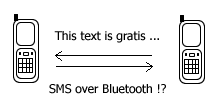
If Bluetooth standard also formalize bluejacking by creating for instance SMS over Bluetooth profile, I think a lot of users will love Bluetooth, especially texting-intensive youngsters.
Product availability
The 3-in-1 phone concept would be very attractive to users had it been followed by the mass production of such phone which hasn't been a reality until now. Browsing the Bluetooth SIG website for products that support a 3-in-1 phone usage model ends up only to the Bluetooth specification document.
Why mobile phone vendors did not race to produce such a phone?
It seems they didn't want to upset cellular operators since in developed markets handsets are channeled through cellular operators. At the time when traditional voice operators (telcos) are facing VoIP challenge, this is a sensitive issue.
I did googling on 3-in-1 Bluetooth phone and found only one such phone, i.e. Sony Ericsson W550i even though there are several Bluetooth chip and PSTN/ISDN access point vendors who stated CTP and ICP support in their products. For example, Broadcom (who acquired Widcomm) makes Bluetooth chip and stack for embedded devices that support CTP and ICP.
If things stay the same in the near future, wouldn't the Bluetooth 3-in-1 phone usage model be buried under the shadow of the increasingly popular VoIP-capable handset? (i.e. VoWLAN or voice over Wi-Fi)
Comparing a 3-in-1 Bluetooth phone with the BT (British Telecom) Fusion's 2-in-1 Bluephone
A Bluephone works as a mobile phone when outside user's home and within BT (MVNO to Vodafone) cellular network. When user walks into his/her house, within a home Bluetooth access point coverage, if he/she is in the middle of a call, the call is switched automatically to BT Broadband landline network via the home access point. The handoff is seamless, without user intervention. This solution is applicable only to BT Broadband subscribers.
Using Bluetooth standard CTP, the switch from/to mobile and cordless is to be decided by the user if he/she is aware of the presence of cheaper landline network. This scenario can work with any mix of fixed and mobile operators.
On the walkie-talkie mode, the direct speech connection (ICP) between two persons within Bluetooth range is completely free peer-to-peer (ad hoc) link without a service provider involvement or a typical office DECT cordless base station and PBX.
Introduction to Bluetooth Profiles
Tuesday, May 09, 2006
Anyone uses a 3-in-1 phone?
A review of forgotten Bluetooth profiles

Friday, April 28, 2006
Why Media is NOT an IEEE standard?
It's hard to find time to catch up with all techno news in this era of information overload. I have an RSS aggregator with more than a dozen feeds but very often after updating the feeds, my concentration was distracted by other activities on my workstation.
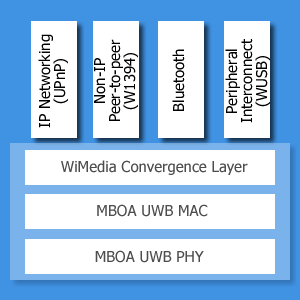
I made a mistake in the previous post because I missed some news. The WiMedia UWB platform hasn't been an IEEE standard yet and is not going to become one because the IEEE 802.15.3a project was disbanded by vote. Why? according to a news source after 3 years of UWB standardization effort, even though the task group (TG3a) has consolidated 23 UWB PHY candidates into 2 proposals, i.e. MB-OFDM and DS-UWB, it failed to reach a consensus on one candidate UWB physical layer (PHY) specification.
Fyi, MB-OFDM is backed by the WiMedia Alliance while DS-UWB is supported by the UWB Forum. The companies involved in developing an IEEE standard always push core parts of their technologies to be incorporated into an upcoming standard in an effort to have time advantage. So it's difficult to unite them.
What's the impact? As with other emerging technologies, having a standard means products from different manufacturers or vendors will be interoperable, therefore consumers won't be locked to one vendor. In the end, it will lead to wider market acceptance and cheaper products for end users. In the absence of a standard, what to expect? Perhaps, the stronger contender becomes the winner and takes all.
This might be a clue. Wireless USB has become a specification in May 2005. WUSB 1.0 resembles USB 2.0 except it is wireless and it runs over WiMedia UWB radio platform. New PCs carrying WUSB radio interface will be out to market in 2006 holiday season according to another news source. Like wired USB, WUSB can do file transfer, DUN, synch, video streaming, peripheral interconnection. It supports 480 Mbps transfer rate at up to 3 meters, 110 Mbps at 10 meters. It also allows devices with dual-role capability (both as host and peripheral) to interconnect, that's USB OTG (On-The-Go). Existing PCs and devices can be WUSB-enabled using an adapter (Wire Adapter).
Whether Bluetooth will embrace both UWB PHYs or choose only the WiMedia's? It's still unclear to me. I have to check it out. But since there are overlaps, what killer apps should the next Bluetooth offer as WUSB is already on the horizon, at the entrance gate?
Friday, April 07, 2006
Bluetooth goes Broadband
What if I can stream music or movie or transfer large files in bulk over Bluetooth? This might have been a question for you too and every Bluetooth enthusiast out there.
Luckily, the Bluetooth SIG seems knowing what we want. A news released in end of March indicated that this organization is committed to the development of a kind of high-speed Bluetooth. It's a version that can enable the transfer of high quality video using today and upcoming Bluetooth application profiles.
To be precise, the Bluetooth SIG is now working together with the WiMedia Alliance to develop the specifications for the delivery of Bluetooth services over WiMedia UWB radio platform (MB-OFDM). Well, finally UWB comes out of its hype stage. Besides Bluetooth that will be UWB-ed, two other technologies (FireWire and USB) have passed assessment process and come into development phase to incorporate the WiMedia UWB into their wireless versions, i.e. Wireless FireWire (W1394) and Wireless USB (WUSB).
What is the benefit for end users? We can enjoy the variety of in-home connectivity at blazing speed and they are wireless. Name the 802.11n (touted as next generation Wi-Fi) that promises 300 - 600 Mbps throughput, Wireless USB up to 480 Mbps, and Wireless FireWire up to 400 Mbps. But Bluetooth - if it succeeds in this endeavor and not late to enter the market - will have a unique place among other options. Bluetooth has rich profiles which is its competitive advantage.
Now if the high speed Bluetooth has a prospect to becoming the choice of the mainstream, how ready are equipment and software makers? I picked another news clipping and it's about the real demonstration of HD video streaming using BLUEtusk (a Bluetooth stack from Open Interface) with Video Distribution Profile (VDP) and Object Push Profile (OPP) over UWB radio from Alereon. With BLUEtusk, actually Bluetooth application can run not only on UWB radio, but also on any TCP/IP-supporting-radio, e.g. Wi-Fi and WiMAX. Open Interface calls it as being radio-agnostic.
However, it remains to be seen how fast Bluetooth over UWB will become a specification. Hopefully, not many years from now. And, that glossary, this dictionary has to change Bluetooth definition one day. But for now, Bluetooth is still a LOW to MEDIUM rate cable replacement and wireless personal area networking technology.
What is your opinion? Do you have a wish to use Bluetooth for video streaming or other broadband applications? What is your current solution?